Fumigation Safety Onboard Ships: Operational Risks, Compliance & Technical Challenges

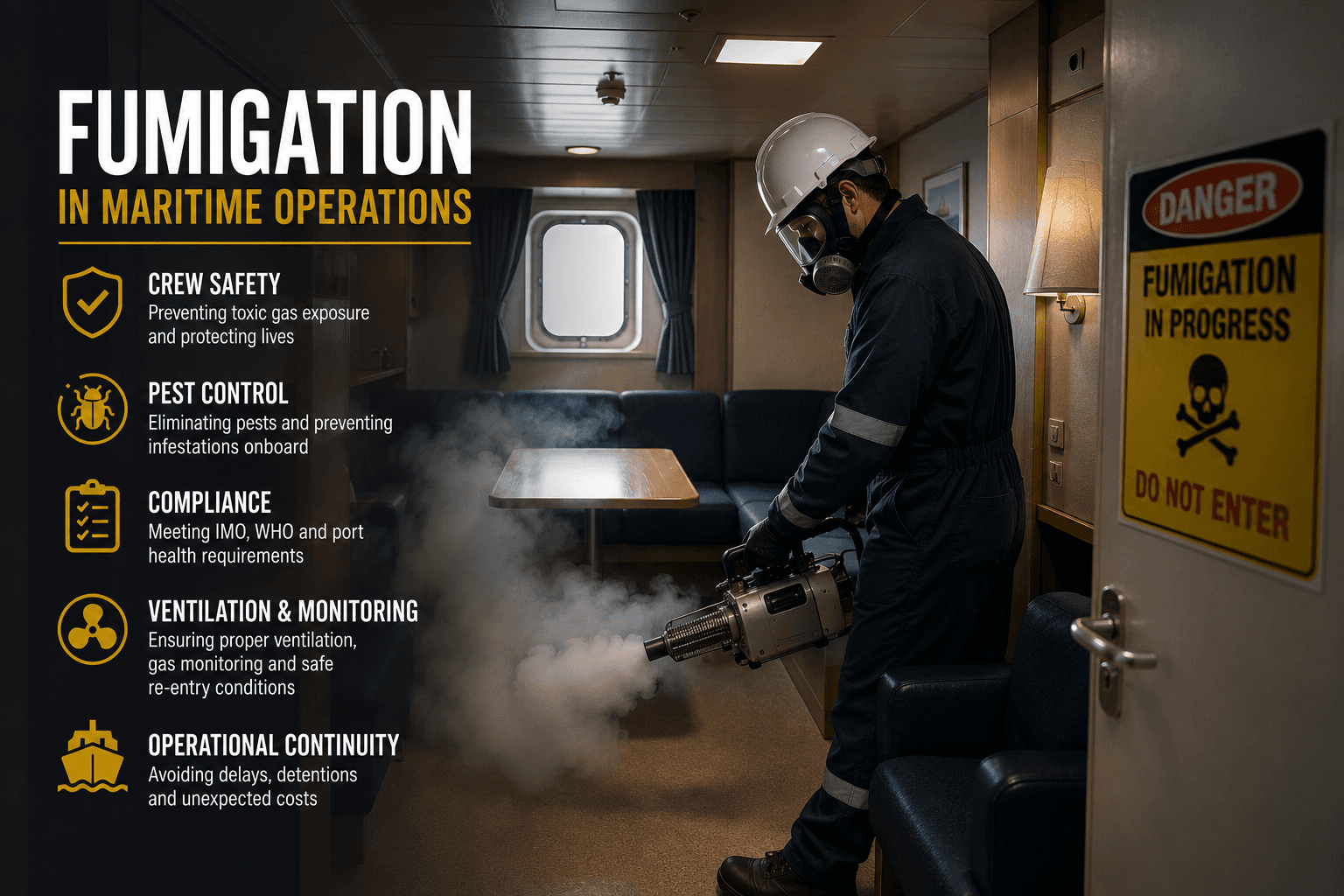
For decades, fumigation onboard vessels was largely considered a standard operational procedure associated with grain cargoes and pest prevention. However, increasing scrutiny from port health authorities, evolving safety expectations, and growing awareness of environmental health risks are changing this perspective significantly.[1]
Today, fumigation is no longer viewed solely as pest elimination. It is directly connected to:
- crew safety,
- cargo integrity,
- enclosed space management,
- operational continuity,
- and regulatory compliance.[2]
Especially following recent discussions regarding biological contamination risks onboard vessels, fumigation procedures are receiving greater operational attention across the maritime industry.[3]
Regulatory Perspective: What Actually Governs Maritime Fumigation?Contrary to common assumptions, fumigation operations are not isolated contractor activities outside maritime regulation.
Several international frameworks indirectly govern onboard fumigation practices.
The International Maritime Organization requires vessels to maintain safe operational conditions during hazardous atmosphere exposure operations through:
- SOLAS Convention,
- enclosed space entry procedures,
- and cargo safety requirements under the IMSBC Code.[4]
In parallel, the World Health Organization framework under the:
- International Health Regulations
allows port authorities to request sanitation verification, fumigation related documentation, or impose operational restrictions when health risks are identified onboard.[5]
Why Fumigation Is Becoming a PSC & Operational ConcernPort State Control inspections are increasingly focused on:
- hazardous atmosphere awareness,
- enclosed space safety,
- crew familiarization,
- and onboard health related risk management.[6]
In many cases, operational deficiencies originate not from the fumigation chemical itself, but from surrounding technical failures such as:
- inadequate ventilation,
- defective dampers,
- poor compartment sealing,
- or uncontrolled access into treated spaces.[7]
These failures may lead to:
- toxic gas exposure,
- operational delays,
- failed inspections,
- and serious crew safety incidents.[8]
From a ship repair and technical management perspective, fumigation should never be approached solely as a chemical treatment process.
It is equally:
- a ventilation management issue,
- a confined space safety issue,
- and a technical readiness matter.[9]
Before major fumigation operations, vessels should verify:
- ventilation fan operational condition,
- airflow efficiency,
- hatch sealing integrity,
- gas detection equipment readiness,
- and emergency ventilation capability.[10]
This proactive approach significantly reduces:
- operational downtime,
- exposure risks,
- port health deficiencies,
- and unexpected delays during cargo operations.
“Effective fumigation is not only about eliminating pests. It is about protecting the operational ecosystem of the vessel.”References
[1] IMO – Maritime safety and operational guidance
[2] WHO – Environmental health risks in transport operations
[3] Port health authority operational advisories (2025–2026)
[4] SOLAS Convention & IMSBC Code
[5] International Health Regulations (IHR 2005)
[6] Paris MoU & Tokyo MoU PSC inspection focus areas
[7] Enclosed Space Entry Incident Reports – Maritime Safety Publications
[8] Marine accident investigations involving hazardous atmospheres
[9] RMS Ship Repair operational safety perspective
[10] Industry best practices for ventilation and atmosphere management